What Is Keyword Clustering and How to Do It?
Keyword clustering step by step. How to group keywords by Google results, define search intent and turn clusters into a content plan without cannibalization.


Keyword clustering is grouping keywords for which Google shows the same pages into sets that a single piece of content can cover. The most reliable criterion is shared URLs in the top 10, because they come from the search engine itself and not from word similarity. This turns a list of several hundred keywords into a content plan in which every cluster is one article.
Keyword clustering, also called keyword grouping, turns a list of 50 to 500 keywords into keyword clusters, each of which becomes one article. It answers how many pieces you need to write and which related keywords each one should cover. This guide is for SEO specialists, editors and agencies with a list of a few dozen to a few hundred keywords who want to turn it into a concrete publishing plan.
What keyword clustering is
Keyword clustering splits a keyword list into thematic groups, each of which one page can cover. What decides membership in a group is search intent, meaning what the user really wants, so keywords with the same underlying need map to one URL. The best external trace of intent is Google's search results. If the search engine shows the same pages for two keywords, it considers the same content to answer both.
Word similarity is a poor guide here. "How much does a heat pump cost" and "is a heat pump worth it" sound alike and both are about money, yet in our measurement they share no result in the top 5. The first leads to price guides and cost calculators, the second to cost-benefit analyses and comparisons with other heating systems.
A keyword cluster differs from a topic cluster. A keyword cluster is a set of keywords for one page. A topic cluster is a group of pages around one topic, a pillar page and related detailed articles connected with internal links. Keyword clustering is the first step toward planning such a topic cluster.
Three methods of grouping keywords
You can approach keyword grouping in three ways, by hand or with a clustering tool, and they differ in what the decision is based on and the scale at which they make sense.
| Method | What it bases the decision on | When it works | What it misses |
|---|---|---|---|
| Manual, by intent | An editor's judgment of whether keywords ask the same thing | A few dozen keywords in a familiar niche | With hundreds of keywords it is slow and depends on the person |
| Semantic | Similarity of the meaning of the keyword text | First pass over large lists | Intent differences between similar wordings |
| By Google results | The number of shared URLs in the top 5 or top 10 | A content plan where every piece counts | Keywords without results and new topics without a SERP |
In my view, clustering by Google results should be the default for a content plan, because it is the only method based on how the search engine actually understands the keywords. Editorial judgment is useful at the end, to settle borderline cases and name the clusters.
"If Google results change, won't the clusters be outdated in a month?"
Individual positions change, while the set of pages for a given intent is usually more stable. Keyword clustering needs a fresh run for a major content plan update, and not for every new piece.
How to do keyword clustering step by step
Keyword clustering takes six steps that turn a list of 50 to 500 keywords into a publishing plan. You collect keywords, clean the list, pull the top 10, count shared results, name the clusters and pick a primary keyword.
1. Collect keywords
Start with the queries your site already appears for, from the performance report in Google Search Console. Add related keywords from keyword research tools, questions from the "People also ask" box and related searches at the bottom of Google results. You can also collect them for free in Google Ads Keyword Planner (it requires a Google Ads account) and in the suggestions Google shows as you type a query. One content plan usually needs 50 to 500 keywords from one topic area.
2. Clean the list
Remove duplicates, typos and off-topic keywords, for example those with competitor brand names if you do not plan to write about them. Keep keywords with near-zero search volume when they are real customer questions, because they work well as follow-up questions inside your articles.
3. Pull Google results for every keyword
For each keyword, record the URLs in the top 10 for the country and language you publish in. With a few dozen keywords you can do this by hand in an incognito window, and with hundreds you need a clustering tool that pulls live results automatically, because historical keyword database exports do not show today's SERP.
4. Count shared results and set a threshold
A typical starting point is 3 shared URLs in the top 5 or 4 in the top 10. For every pair of keywords, count how many URLs appear in both result sets. The threshold is the minimum number of shared URLs at which keywords go into one cluster, for example 3 of 5 or 4 of 10. A higher threshold gives narrower clusters and more articles, and a lower one gives broader clusters with a risk of merging different intents.
You also choose between hard and soft clustering. In hard clustering, every pair of keywords in a cluster has to meet the threshold. In soft clustering, each keyword only has to meet it with the cluster's primary keyword. In our heat pump example below, hard clustering at 3 of 5 leaves "installation cost" out of the cost cluster, while soft clustering around "heat pump price" keeps all three cost keywords together.
5. Name the cluster and define its intent
Name each keyword cluster with a 2-5 word phrase that describes the topic and becomes the working title of the article, for example "heat pump cost". Define the intent based on the type of pages in the results, such as guides, comparisons, online stores or service pages.
6. Choose the primary keyword
The primary keyword is usually the one with the highest search volume or the one that best describes the intent. The other keywords in the cluster go into the article as variants, subheadings and answers to follow-up questions.
A keyword clustering example with 8 heat pump keywords
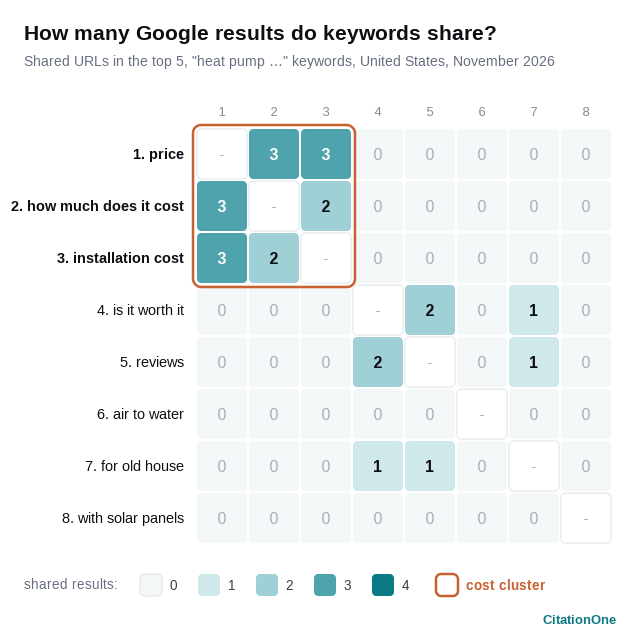
This example shows clustering on real Google results. We pulled the results for 8 heat pump keywords (United States, English, November 2026) and counted the shared URLs in the top 5. Google returned 6 to 9 organic results on the first page for these keywords.
| Keyword pair | Shared in top 5 | Shared in top 10 |
|---|---|---|
| heat pump price + how much does a heat pump cost | 3 | 6 |
| heat pump price + heat pump installation cost | 3 | 4 |
| how much does a heat pump cost + heat pump installation cost | 2 | 5 |
| is a heat pump worth it + heat pump reviews | 2 | 4 |
| is a heat pump worth it + heat pump for old house | 1 | 2 |
| how much does a heat pump cost + is a heat pump worth it | 0 | 1 |
| other pairs | 0 | 0-2 |
This table leads to three conclusions:
- Keywords about price, cost and installation form one cluster, which one article on heat pump costs can cover, with a separate section on installation.
- "Is a heat pump worth it" is a separate article even though it is about money, because Google shows cost-benefit analyses for it and not price guides.
- "Air to water heat pump", "heat pump for old house" and "heat pump with solar panels" are three more articles, each with its own intent.
The borderline cases are more interesting. "How much does a heat pump cost" and "heat pump installation cost" share only 2 results in the top 5 but 5 in the top 10. With a threshold of 3 of 5 and the rule that every pair in a cluster has to meet it, installation cost would go into a separate group. This is where the editorial decision comes in. Installation is part of the cost question, so it is better to cover it in the same article than to write two that compete with each other.
"Is a heat pump worth it" and "heat pump reviews" show the opposite case. They share 2 of 5 and 4 of 10, so a top 5 threshold keeps them apart and a top 10 threshold joins them. If the reviews results show owners' experiences with costs and savings, one article on whether a heat pump is worth it, with a section on owner reviews, can cover both.
How to turn clusters into a content plan
A content plan assigns one article to each cluster, so one cluster means one article, and the cluster's primary keyword is the topic of the title. Set the publishing order by two criteria:
- The total search volume of all keywords in the cluster, and not only the primary keyword.
- How close the cluster is to your offer, because the "how much does a heat pump cost" cluster attracts people closer to buying than "how does a heat pump work".
When several clusters belong to one broad topic, plan them as a topic cluster. The broad topic gets a pillar page that answers in general terms and links to the detailed articles, and every detailed article links back to the pillar. The internal linking tool prepares suggestions for such links on an existing site.
Before you write a new article, check whether your site already has a page for that cluster. If it does, it is better to update it than to create a second one. We explain how in How to update old blog posts for SEO and AI.
Keyword clustering and visibility in AI answers
An article written for a whole cluster has a better chance of being cited in AI answers. Google describes how AI Overviews and AI Mode use query fan-out (splitting a question into many related searches on subtopics). A page that covers all the keywords in a cluster and its follow-up questions has more passages matching those searches than several short pages written for single variants.
The fan-out and AIO coverage dimension measures how many follow-up questions a finished article covers. We describe how to write sections that AI likes to cite in How to write content for AI search.
Common keyword clustering mistakes
Five mistakes come up in content plans regardless of industry:
- A separate article for every keyword variant, which ends in cannibalization, with your own pages competing for the same query.
- Grouping by shared words in place of Google results, which merges different intents.
- A threshold that is too low, at which a single shared result, such as a forum thread, glues together keywords with different intent.
- Ignoring existing pages, so the new article competes with an old one.
- Choosing the primary keyword by volume alone, without checking that it matches the type of pages in the results.
Google's spam policies describe doorway abuse as pages created to rank for specific, similar queries that lead users to less useful intermediate pages. Keyword clustering prevents this problem at the planning stage, because every intent gets one complete page.
The content pruning tool flags existing pages that already cannibalize each other.
Summary
Keyword clustering turns a keyword list into a plan in which every cluster is one article. The most reliable criterion is shared results in Google, and the threshold of shared URLs is worth testing on borderline cases before you approve the plan. Start with keywords from Search Console, pull their results and compare the pairs. Even with 20 keywords, you will see how many articles you really need.
Group your keywords with the CitationOne keyword clustering tool to get clusters with intent, search volume and a suggested pillar page, plus a CSV export.
Frequently asked questions
How many shared results put keywords in one cluster?
The most common threshold is 3 of 5 or 4 of 10 shared URLs in Google results. A higher threshold gives narrower clusters and more articles, while a lower one merges broader groups but raises the risk of mixing different intents. Borderline cases, such as 2 shared results, are worth reviewing by hand.
What is a keyword cluster example?
A keyword cluster example is "heat pump price", "how much does a heat pump cost" and "heat pump installation cost". In US Google results these keywords share 3 of their top 5 results in pairs, so one article on heat pump costs can cover all three. "Is a heat pump worth it" has no shared top 5 results with them, so it needs its own article.
What is the difference between a keyword cluster and a topic cluster?
A keyword cluster is a set of keywords that one page covers. A topic cluster is a group of pages around one topic, a pillar page and detailed articles connected with internal links. Keyword clustering shows how many pages a topic cluster needs and what each of them should be about.
Can you do keyword clustering in Excel?
With a few dozen keywords, yes. Record the top 10 URLs for each keyword in columns and count the shared URLs for each pair with a lookup function. With several hundred keywords, the number of pairs grows into the tens of thousands, so a tool that pulls the results and computes the overlap automatically is more practical.
Can you do keyword clustering for free?
You can do keyword clustering for free with Search Console data, a spreadsheet and manual Google searches, which works for a few dozen keywords. For larger lists, a clustering tool saves days of work. In CitationOne, every new account gets 3 free credits, and one clustering job costs 1 credit.
What should you do with keywords that do not fit any cluster?
A keyword with no shared results with others has its own intent. If it has search volume and fits your offer, it gets its own article. If it is a niche question, you can answer it in the FAQ section of the article from the closest related cluster.
Sources
- Google Search Central, Optimizing your website for generative AI features on Google Search, accessed 2026-11-15.
- Google Search Central, Spam policies for Google web search, accessed 2026-11-15.
- Search Console Help, Performance report, accessed 2026-11-15.
- CitationOne, Google results for 8 heat pump keywords (United States, English), pulled in November 2026.